How to use
Teaching text from the supplied slides, with each slide beside the part it goes with. This is a reading edition of the deck; a full talk script has not been supplied.
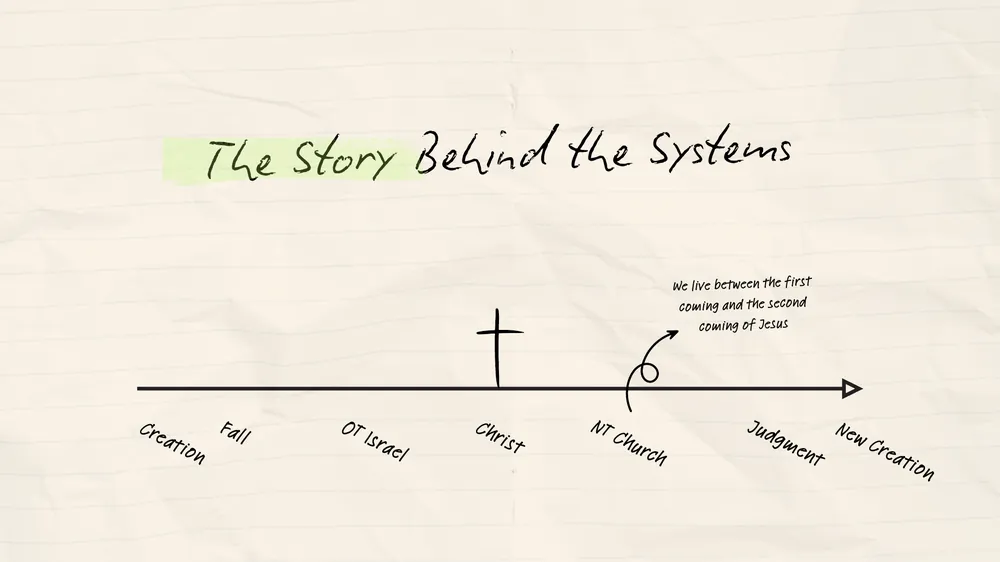
The story behind the systems
We live between the first coming and the second coming of Jesus
Creation → Fall → OT Israel → Christ → NT Church → Judgment → New Creation
Ecclesiology
Ecclesiology is the theological study of the Christian Church itself. Originating from the Greek word ekklesia (meaning "assembly" or "congregation") and logos (meaning "study"), it examines the church's origins, nature, purpose, structure, leadership, and its relationship to Jesus Christ.
The Church is…
- Body of Christ (Romans 12:4-8)
- Temple of the Holy Spirit (Ephesians 2:19-22)
- Bride of Christ (Revelation 19:6-9)
- People of God (Titus 2:14)
- Household / Family of God (1 Timothy 3:15)
- Royal Priesthood & Holy Nation (1 Peter 2:9-10)
- New Humanity (Colossians 3:9-17)
- Flock & Branches (John 10 & 15)
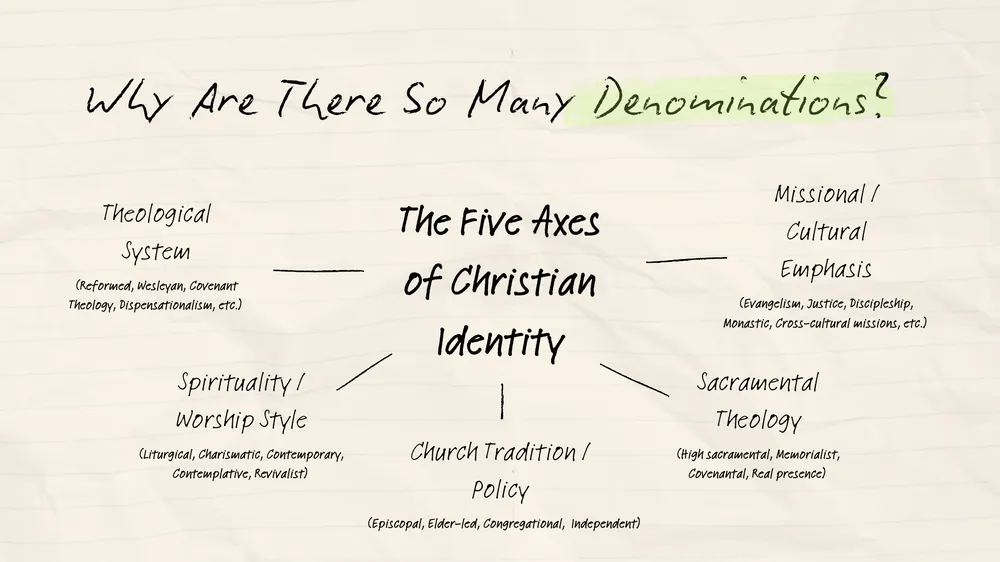
Why are there so many denominations?
The Five Axes of Christian Identity
- Theological System (Reformed, Wesleyan, Covenant Theology, Dispensationalism, etc.)
- Spirituality / Worship Style (Liturgical, Charismatic, Contemporary, Contemplative, Revivalist)
- Church Tradition / Policy (Episcopal, Elder-led, Congregational, Independent)
- Sacramental Theology (High sacramental, Memorialist, Covenantal, Real presence)
- Missional / Cultural Emphasis (Evangelism, Justice, Discipleship, Monastic, Cross-cultural missions, etc.)
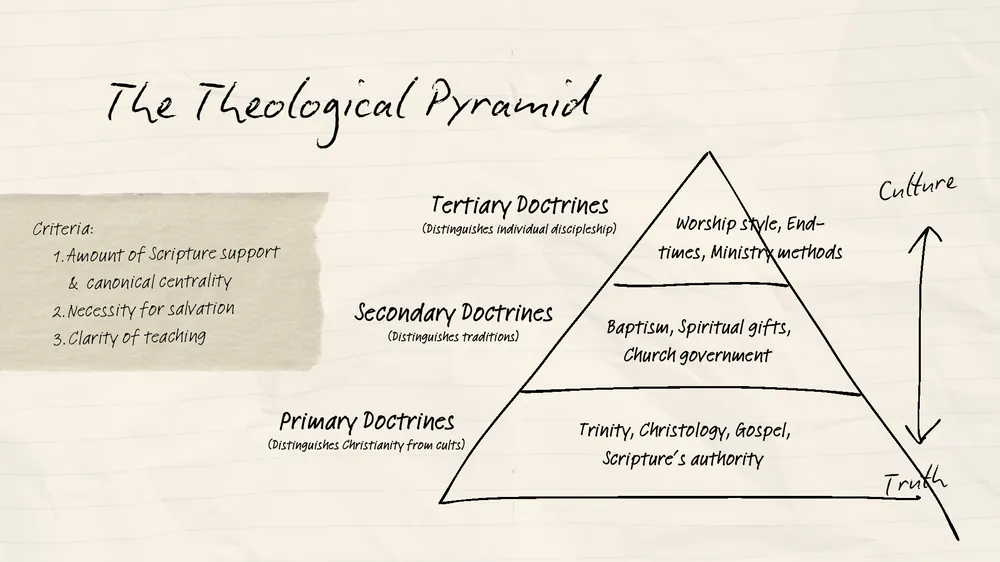
The theological pyramid
Criteria:
- Amount of Scripture support & canonical centrality
- Necessity for salvation
- Clarity of teaching
- Primary Doctrines (Distinguishes Christianity from cults): Trinity, Christology, Gospel, Scripture’s authority
- Secondary Doctrines (Distinguishes traditions): Baptism, Spiritual gifts, Church government
- Tertiary Doctrines (Distinguishes individual discipleship): Worship style, End-times, Ministry methods
Truth → Culture
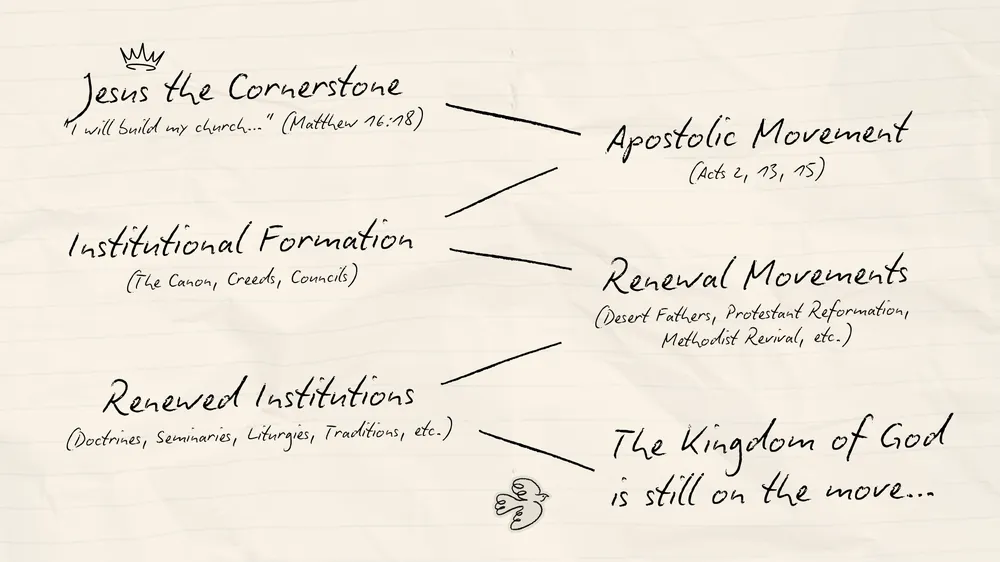
The Church through history: movements & institutions
- Jesus the Cornerstone: “I will build my church…” (Matthew 16:18)
- Apostolic Movement (Acts 2, 13, 15)
- Institutional Formation (The Canon, Creeds, Councils)
- Renewal Movements (Desert Fathers, Protestant Reformation, Methodist Revival, etc.)
- Renewed Institutions (Doctrines, Seminaries, Liturgies, Traditions, etc.)
The Kingdom of God is still on the move…
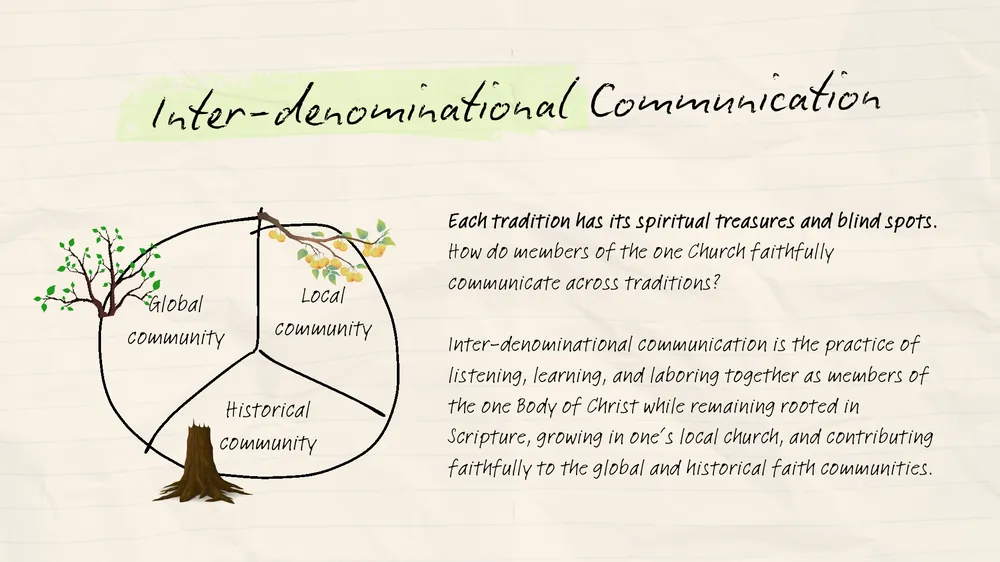
Inter-denominational communication
Each tradition has its spiritual treasures and blind spots. How do members of the one Church faithfully communicate across traditions?
Inter-denominational communication is the practice of listening, learning, and laboring together as members of the one Body of Christ while remaining rooted in Scripture, growing in one’s local church, and contributing faithfully to the global and historical faith communities.
Global community · Local community · Historical community
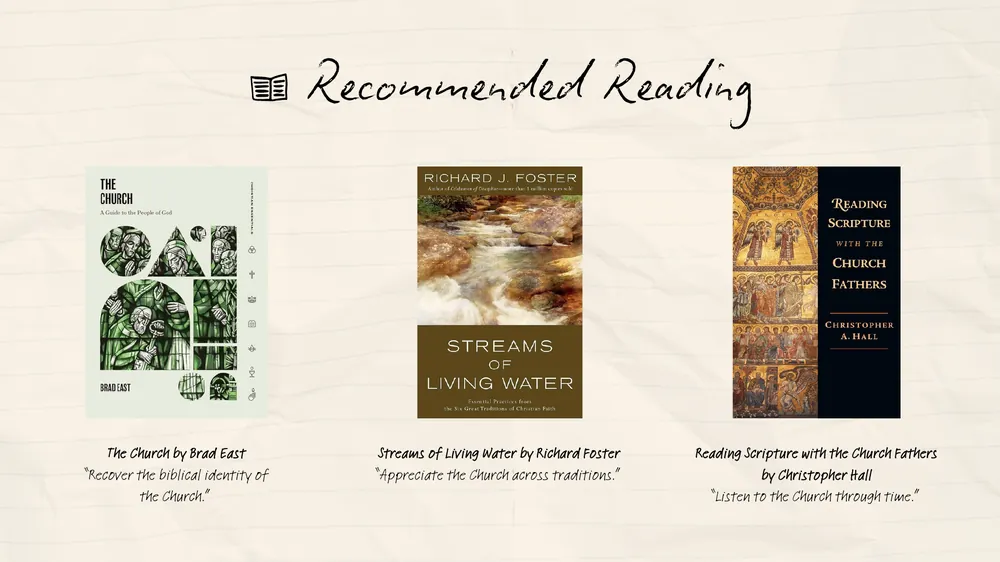
Recommended reading
- The Church by Brad East — “Recover the biblical identity of the Church.”
- Streams of Living Water by Richard Foster — “Appreciate the Church across traditions.”
- Reading Scripture with the Church Fathers by Christopher Hall — “Listen to the Church through time.”
Why does ecclesiology matter?
Because how we imagine the Church determines:
- How we worship
- How we disciple
- How we lead
- How we engage the world
The Church becoming more like Christ
The goal of ecclesiology is to help the Church become more like Christ.
There is one body and one Spirit, just as you were called to one hope when you were called; one Lord, one faith, one baptism; one God and Father of all, who is over all and through all and in all.
Ephesians 4:4–6
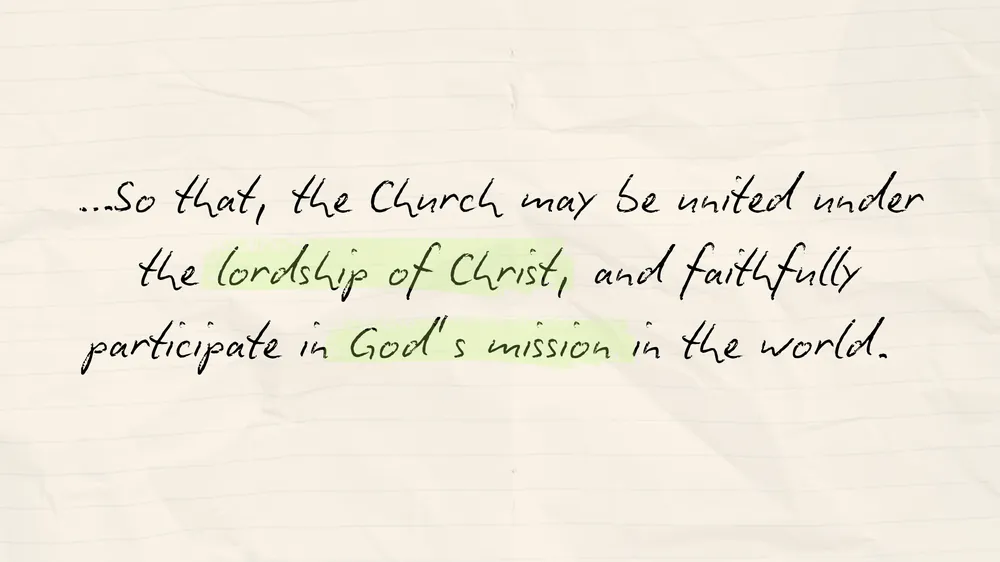
…So that, the Church may be united under the lordship of Christ, and faithfully participate in God’s mission in the world.
Thank you
The Garden Project
The slides
All 15 slides in one PDF, ready to project or print.
Bring it to your group
These resources may be used in churches, small groups, classes, discipleship cohorts, workshops, retreats and personal study. Before you lead one:
- Adapt the examples to your local context.
- Keep the biblical and theological structure.
- Don’t remove the formation practices just to save time.
- Prepare your facilitators before the group begins.
Full facilitator guides, with setup, timing, safety notes and discussion questions, are available on request. For teaching, publishing, translation, partnership or licensing, contact The Garden Project.