How to use
The talk as written for the workshop, with each slide and graphic beside the part it goes with.
The story the Bible echoes
At the burning bush, Moses asked God for reassurance, and God gave him a strange sign: “I will be with you. And this will be the sign to you that it is I who have sent you: When you have brought the people out of Egypt, you will worship God on this mountain” (Exodus 3:12). The sign was not the plagues or the parting of the sea. It was a gathering that had not happened yet. Before a single Israelite left Egypt, God had already told Moses where the journey was going. Liberation was a means to an end, and the end was the restoration of the covenant relationship between Yahweh and His people.
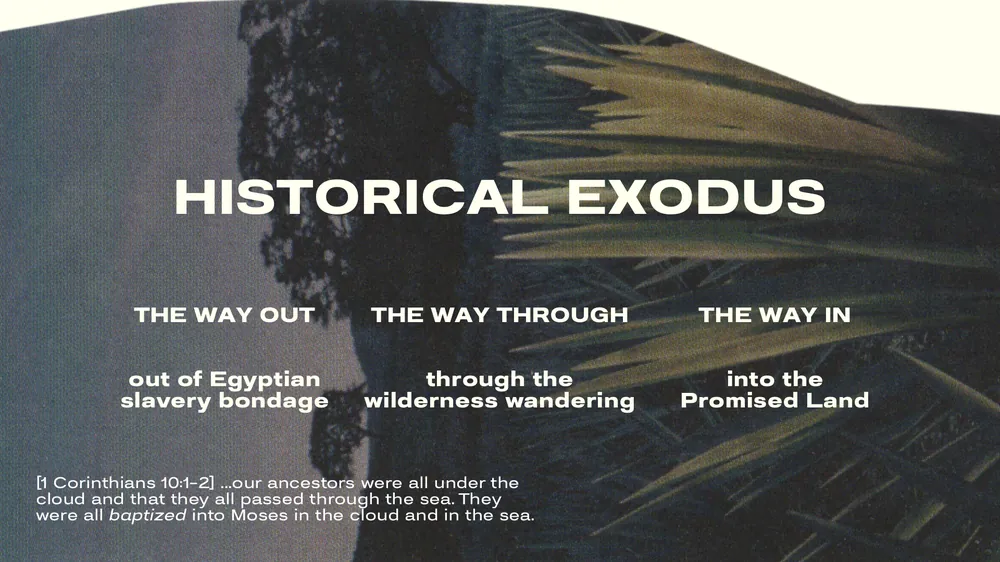
Many of us know the Exodus as a dramatic rescue: the plagues, the parted sea, Moses with his staff raised high. But as the Bible Project puts it, “The Exodus isn’t just one story in the Bible. It’s the story the rest of the Bible echoes.” The word exodus comes from Greek, ex (“out”) and hodos (“way” or “road”), so it literally means “the way out.” However, the story does not stop at the way out. It moves in three directions: the way out, the way through, and the way in. Together they form the framework I call the Exodus Way.
The Exodus Way is a lens with three uses. First, it helps us read the historical Exodus as a journey rather than a single event of escape. Second, it helps us see the New Exodus that Jesus inaugurated through his death, burial, and resurrection. Third, it marks out a road of transformation for those who follow him today. Hold on to the three movements; they are the map for everything that follows.
The way out was only the beginning
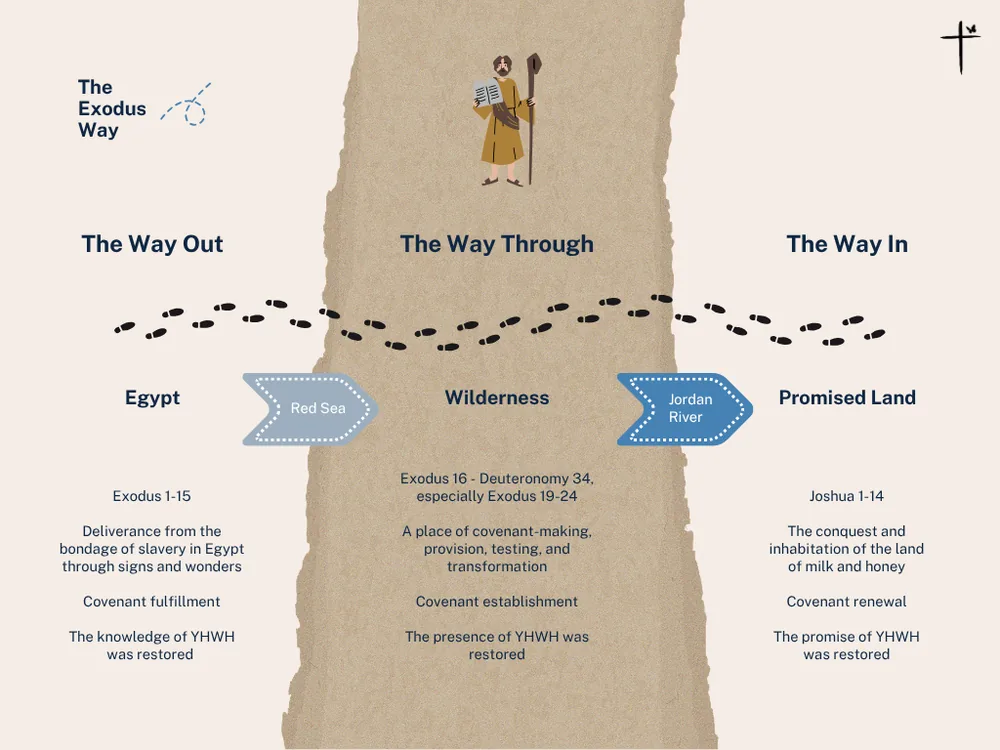
The book of Exodus begins with God’s people in exile, slaves in a land that was not theirs. What is exile? Old Testament theologian L. Michael Morales explains, “Exile is not merely being removed from land—it is being removed from God’s presence. The exodus is God bringing His people near; exile is the tragic reversal of that nearness.” So the Exodus is a reversal of exile, and it unfolds along a road with two crossings: the Red Sea and the Jordan River. On each part of that road, Yahweh restored something His people had lost.
The way out runs from Egypt to the Red Sea (Exodus 1–15). Yahweh delivered Israel from the bondage of slavery through signs and wonders. What set the whole event in motion was that God “remembered his covenant with Abraham, with Isaac and with Jacob” (Exodus 2:24), so the way out is a story of covenant fulfillment. Through the plagues and the sea, Yahweh made Himself known to both Israel and the nations, and from then on His name was tied to their salvation: “I am the LORD your God, who brought you out of Egypt, out of the land of slavery” (Exodus 20:2). The knowledge of Yahweh was restored. Centuries later, the Apostle Paul read the crossing as a kind of baptism: “our ancestors were all under the cloud and that they all passed through the sea. They were all baptized into Moses in the cloud and in the sea” (1 Corinthians 10:1-2). Keep that word “baptized” in mind; we will come back to it.
The way through is the wilderness (Exodus 16 to Deuteronomy 34, especially Exodus 19–24). It was a place of covenant-making, provision, testing, and transformation. At Sinai, God established His covenant with Israel and called them “a kingdom of priests and a holy nation” (Exodus 19:6). He fed them with manna every morning and led them by a pillar of cloud and fire. Then He gave the instructions for the tabernacle: “Have them make a sanctuary for me, and I will dwell among them” (Exodus 25:8). When the glory of the LORD filled the tabernacle (Exodus 40:34), the presence of Yahweh was restored. Forty years of wandering is real hardship, and we should not romanticize it. But the wilderness is where God forms His people, testing and teaching them to walk by faith.
The way in crosses the Jordan River into the Promised Land (Joshua 1–14). Under Joshua, a new generation entered and inhabited the land of milk and honey and renewed the covenant their parents had made at Sinai (Joshua 5; 8:30–35). This is where the promises of Yahweh were restored. Long before, God had said, “I will bring you to the land I swore with uplifted hand to give to Abraham, to Isaac and to Jacob. I will give it to you as a possession” (Exodus 6:8). The Promised Land is not just a destination; it is the lived reality of God’s covenantal faithfulness.
So the way out was only the beginning. At every step of the road, God kept His covenant: He fulfilled His promise to Abraham by bringing Israel out, established His covenant with them in the wilderness, and renewed it as they entered the land. And at every step, He gave back what exile had taken away: the knowledge of Himself, His presence among His people, and His promises to them. The Exodus is not a story of escape but a story of homecoming.
The New Exodus
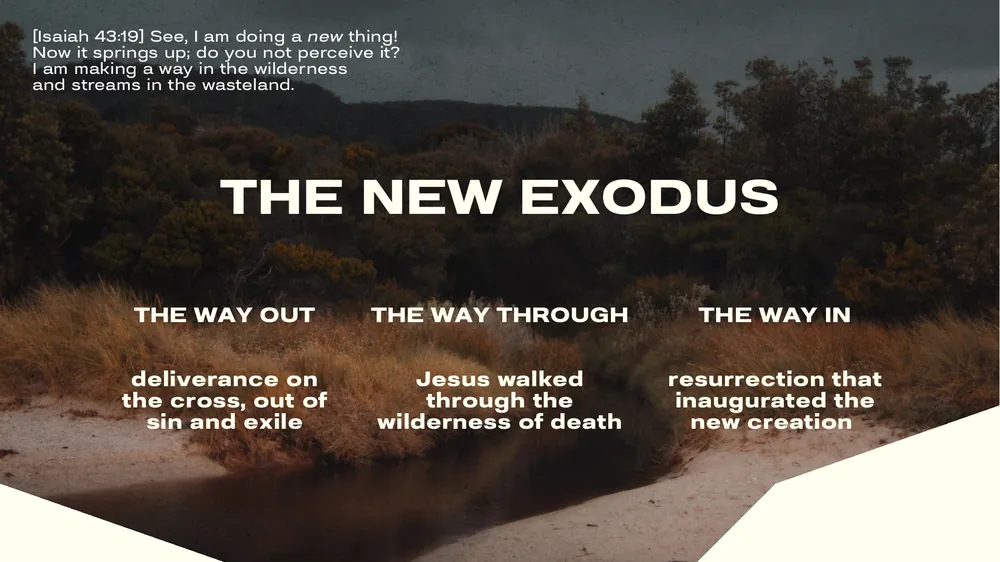
Israel’s story did not stay in the land. Unfaithfulness led to another exile, this time in Babylon. Yet the Psalms and the Prophets kept the Exodus road alive, depicting a New Moses figure and anticipating a greater Exodus, when Yahweh Himself would return and restore. Through Isaiah, God spoke in the language of the first exodus: “See, I am doing a new thing! Now it springs up; do you not perceive it? I am making a way in the wilderness and streams in the wasteland” (Isaiah 43:19).
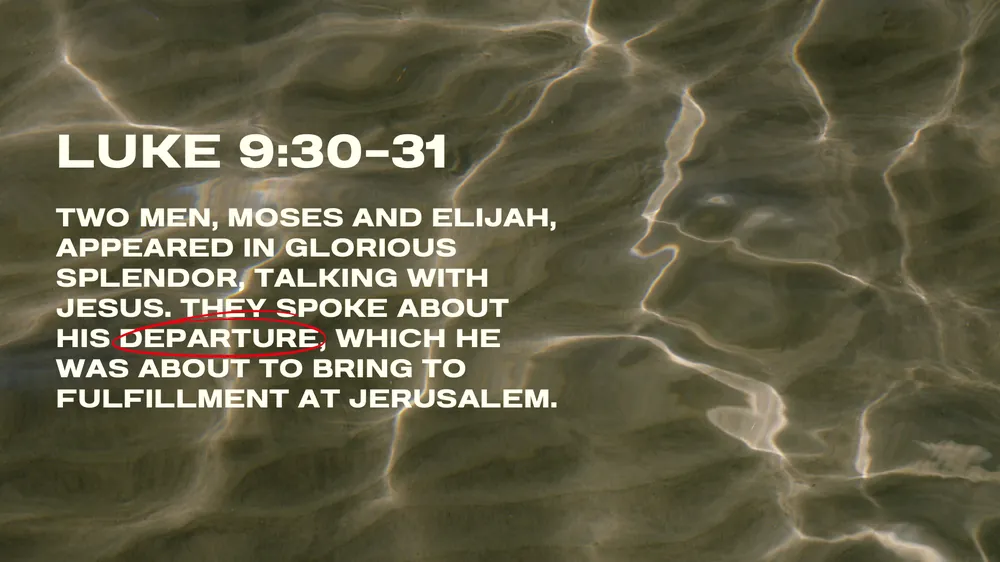
Then came a mountaintop. Jesus took Peter, James, and John up to pray, and while he was praying, his face changed and his clothes became as bright as a flash of lightning. “Two men, Moses and Elijah, appeared in glorious splendor, talking with Jesus. They spoke about his departure, which he was about to bring to fulfillment at Jerusalem” (Luke 9:30-31). The Greek word for “departure” is exodos. Of all the things the great lawgiver and the great prophet could have discussed with the Son of God, they talked about his exodus.
What did they mean by “Jesus’ exodus”? The mission of Jesus can be summarized as the New King inaugurating the New Creation through the New Exodus. Seen through the Exodus Way, his death, burial, and resurrection are that New Exodus:
- The way out: his death. On the night of the Passover meal, the Sacrificial Lamb went to the cross and brought deliverance for all humanity, out of sin and exile.
- The way through: his burial. Jesus walked through the wilderness of death and rested in the tomb after the work of redemption was finished.
- The way in: his resurrection. Jesus conquered death and opened the way into all things new in the Kingdom of God.
The New Exodus is already accomplished, and yet God’s people are still on the road toward its fullness.
A new covenant, sealed by his blood
Throughout the Scripture, the covenants God makes come with signs that mark the relationship and bear witness to it: the rainbow for Noah (Genesis 9:13-17), circumcision for Abraham (Genesis 17:10-14), the Sabbath and the Torah for Israel at Sinai (Exodus 31:12-17), and the Messianic King and his everlasting Kingdom for David (Psalm 89). So what are the signs of the new covenant?
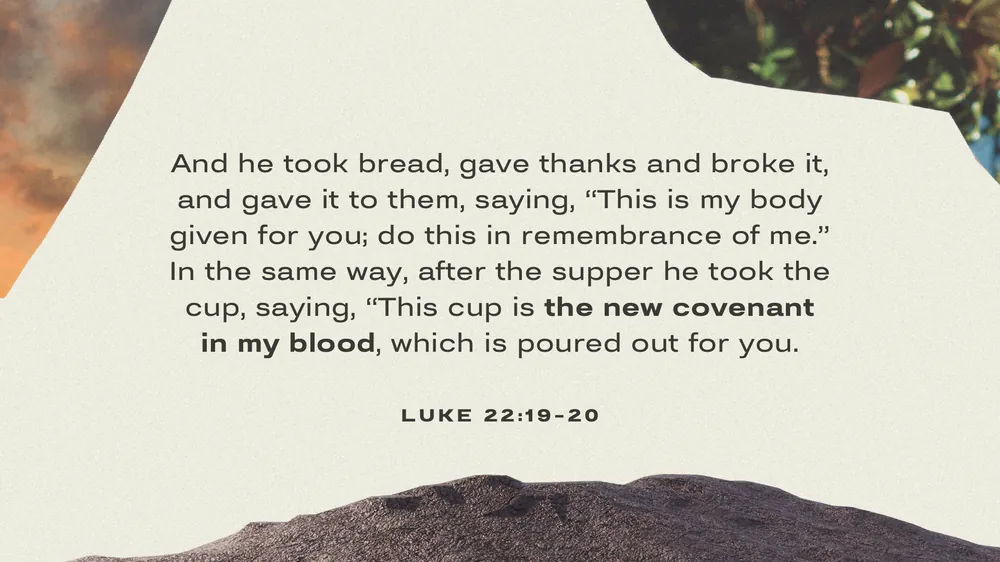
During Holy Week, Jesus told his disciples, “I have eagerly desired to eat this Passover with you before I suffer” (Luke 22:15). At the very meal that remembered the way out of Egypt, he retold the story around himself: “And he took bread, gave thanks and broke it, and gave it to them, saying, ‘This is my body given for you; do this in remembrance of me.’ In the same way, after the supper he took the cup, saying, ‘This cup is the new covenant in my blood, which is poured out for you’” (Luke 22:19-20).
Jesus Christ is the embodiment of the New Covenant, which was established through the New Exodus of his death, burial, and resurrection. As the Bible Project concludes, “Jesus is the way out, the way through, and the way in.” And the new covenant has two signs: baptism (Colossians 2:11-12) and the Lord’s Supper (Luke 22:20; 1 Corinthians 11:23-26). Deeply rooted in the historical Exodus, they carry a significance that goes beyond their symbolic meanings. They are more than memorials of something that happened long ago. They are signs of union with Christ: through them, our lives are joined to his death, burial, and resurrection, and we participate in the new covenant and in the redemptive Story it completes.
Union with Christ: baptism
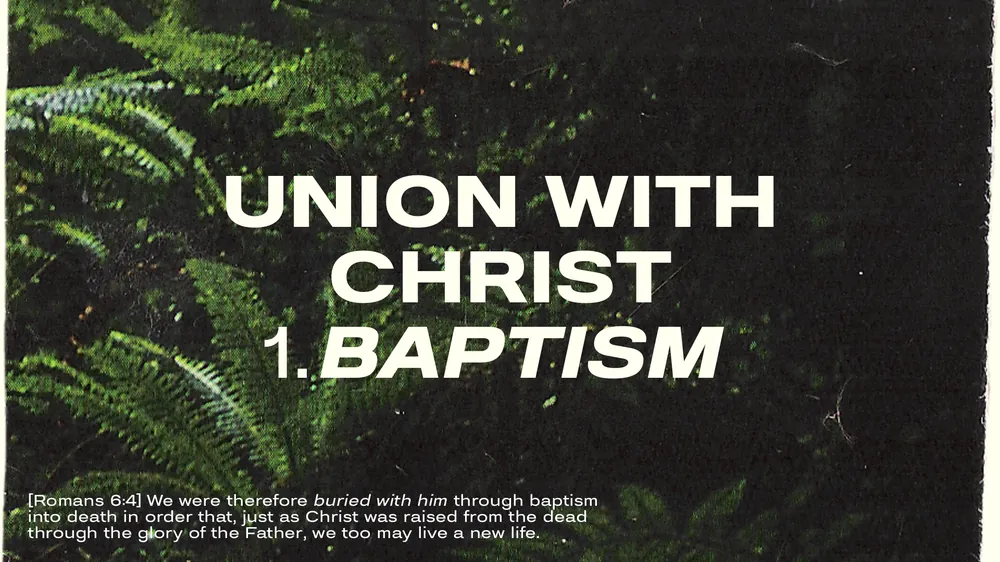
The Apostle Paul writes, “We were therefore buried with him through baptism into death in order that, just as Christ was raised from the dead through the glory of the Father, we too may live a new life” (Romans 6:4). To see how our baptism joins us to Jesus’ exodus, we first need to look at his.
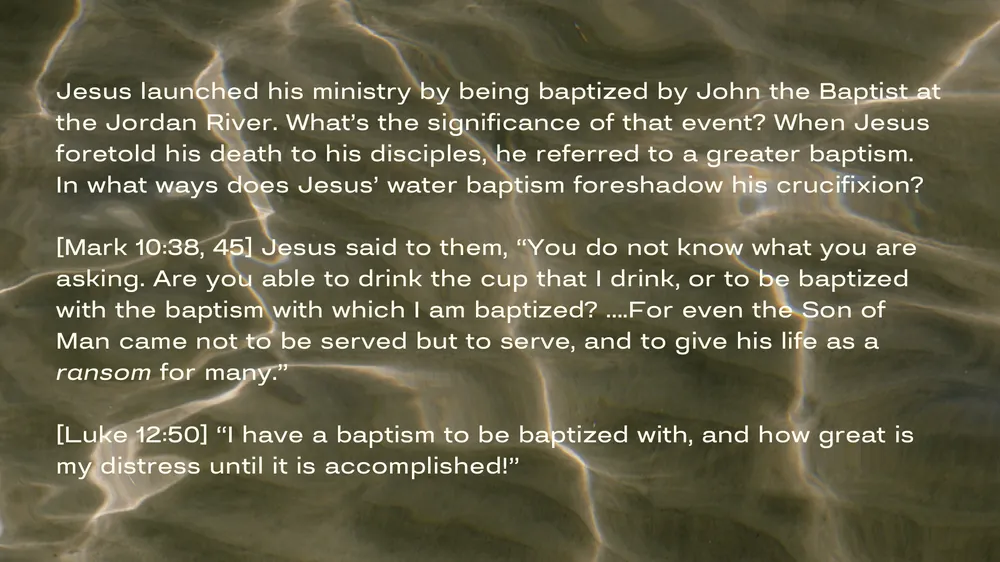
Jesus launched his ministry by being baptized by John the Baptist at the Jordan River. What’s the significance of that event? When Jesus foretold his death to his disciples, he referred to a greater baptism: “You do not know what you are asking. Are you able to drink the cup that I drink, or to be baptized with the baptism with which I am baptized? … For even the Son of Man came not to be served but to serve, and to give his life as a ransom for many” (Mark 10:38, 45). And again, “I have a baptism to be baptized with, and how great is my distress until it is accomplished!” (Luke 12:50). In what ways does Jesus’ water baptism foreshadow his crucifixion? Take a moment with that question before we go on.
Here is what I see. Jesus walked the Exodus road almost in reverse order. Israel came out through the Red Sea, wandered in the wilderness, and crossed the Jordan last. Jesus started at the Jordan, the very river where Israel’s journey ended. Right after his baptism, he “was led by the Spirit into the wilderness, where for forty days he was tempted by the devil” (Luke 4:1-2). Forty days for forty years. Where Israel grumbled for bread, Jesus answered from Deuteronomy: “Man shall not live on bread alone, but on every word that comes from the mouth of God” (Matthew 4:4). Then he set his face toward Jerusalem, where the cross became the greater baptism and the greater Exodus he fulfilled. Jesus began where Israel finished and walked all the way back into the place of bondage, so that he could bring his people out.
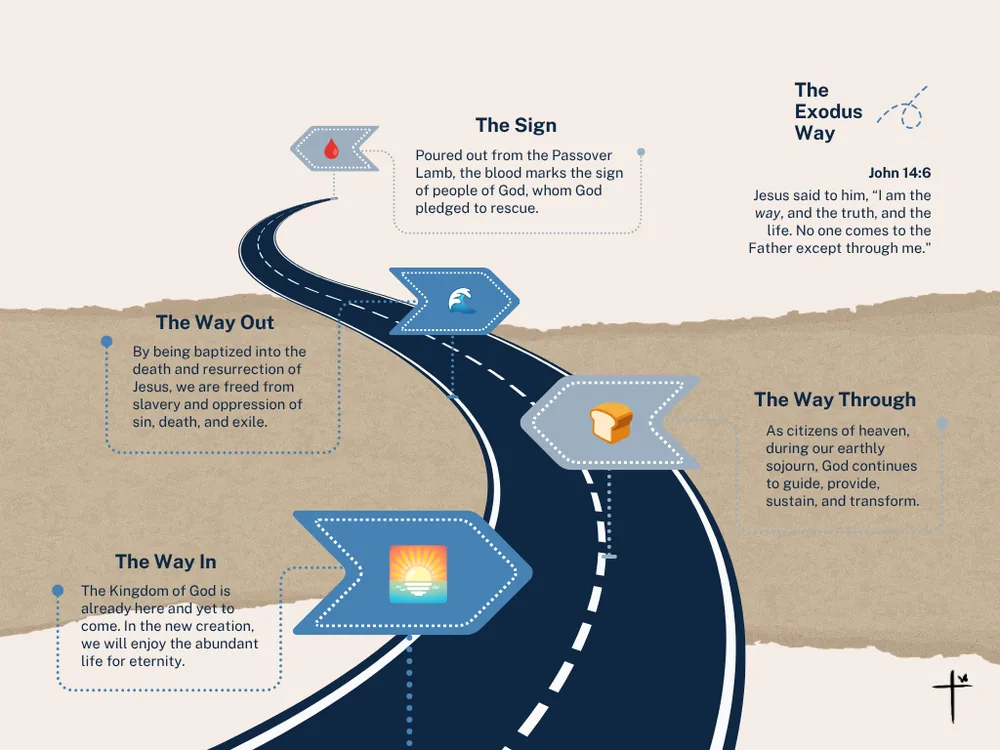
Remember the night of the first Passover. The Israelites painted the blood of a lamb on the sides and tops of their doorframes, and God said, “The blood will be a sign for you on the houses where you are, and when I see the blood, I will pass over you” (Exodus 12:13). Poured out from the Passover Lamb, the blood marks the sign of the people of God, whom God pledged to rescue. At Jerusalem, Jesus became that sacrificial Lamb, his blood poured out on the wood frame of the cross.
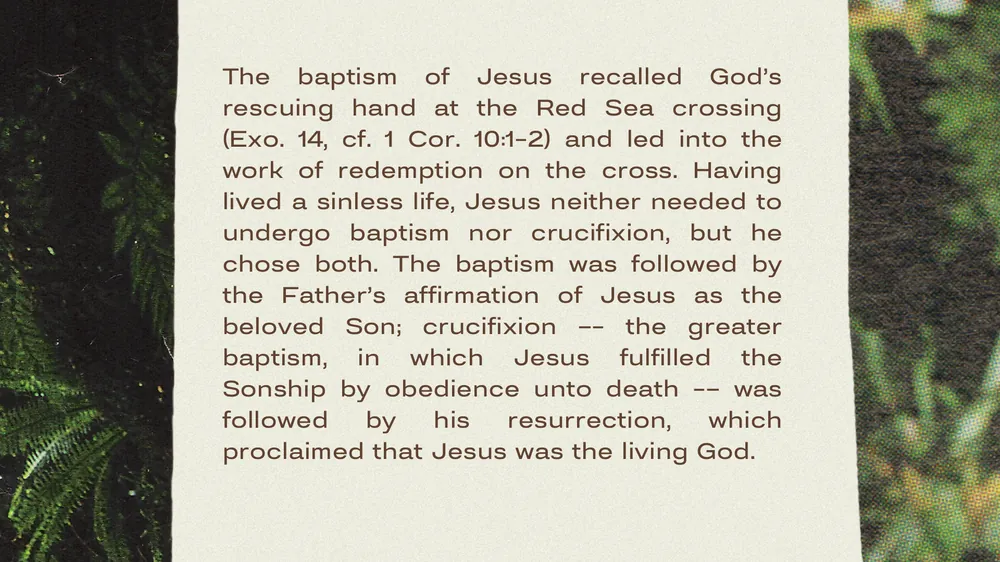
The baptism of Jesus recalled God’s rescuing hand at the Red Sea crossing (Exodus 14, cf. 1 Corinthians 10:1-2) and led into the work of redemption on the cross. Having lived a sinless life, Jesus neither needed to undergo baptism nor crucifixion, but he chose both. The baptism was followed by the Father’s affirmation of Jesus as the beloved Son; crucifixion—the greater baptism, in which Jesus fulfilled the Sonship by obedience unto death—was followed by his resurrection, which proclaimed that Jesus was the living God.
This is why our baptism is more than a ceremony of remembrance. It is union with Christ: “For if we have been united with him in a death like his, we will certainly also be united with him in a resurrection like his” (Romans 6:5). Through baptism in water and the Spirit, we are baptized into God’s family. By being baptized into the death and resurrection of Jesus, we are freed from slavery and oppression of sin, death, and exile. Our baptism is our Red Sea crossing; it is where we step onto the way out with him.
Union with Christ: the Lord’s Supper
If baptism is our Red Sea, the Lord’s Supper is our manna. Israel did not cross the sea once and then fend for themselves; God fed them every morning in the wilderness. Jesus calls himself the true bread from heaven: “I am the bread of life. Whoever comes to me will never go hungry” (John 6:35). And Paul tells us what happens each time the church gathers at the table: “For whenever you eat this bread and drink this cup, you proclaim the Lord’s death until he comes” (1 Corinthians 11:26).
Jesus frequently used banquet imagery to describe the Kingdom of God (Luke 14:15–24; Matthew 22:1–14), and it was not a surprise that Jesus instituted the New Covenant during a Passover feast. What are the connections between the Passover meal, the Lord’s Supper, and the banquet in the Kingdom of God? Here is a clue from the same night: “I tell you I will not drink again of this fruit of the vine until that day when I drink it new with you in my Father’s kingdom” (Matthew 26:29).
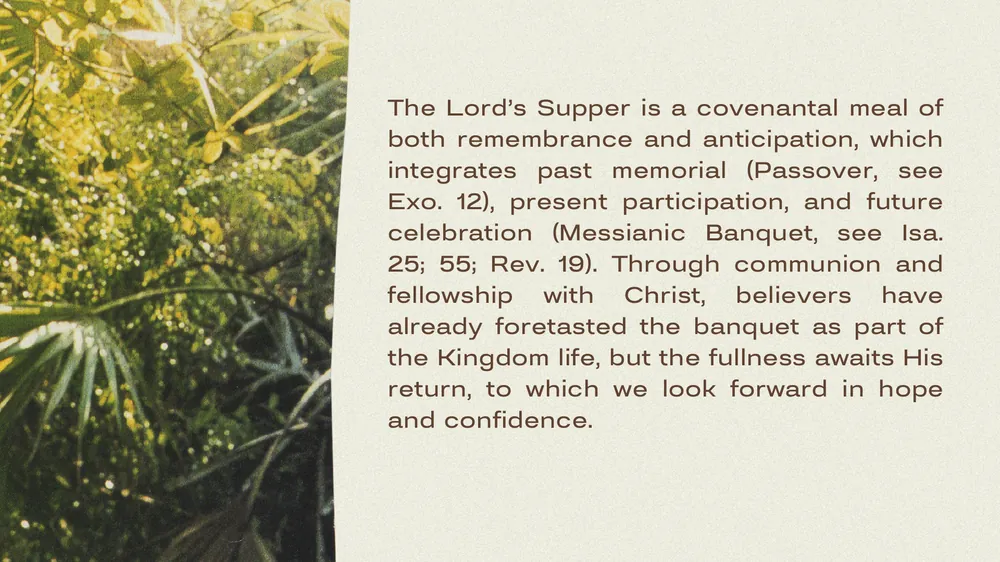
The Lord’s Supper is a covenantal meal of both remembrance and anticipation, which integrates past memorial (Passover, see Exodus 12), present participation, and future celebration (Messianic Banquet, see Isaiah 25; 55; Revelation 19). Through communion and fellowship with Christ, believers have already foretasted the banquet as part of the Kingdom life, but the fullness awaits His return, to which we look forward in hope and confidence.
So the table is not only a memorial; it is where our union with Christ is nourished. Every time we come to it, we are standing in the middle of the road. We look back to the way out, the cross. We look ahead to the way in, the wedding supper of the Lamb (Revelation 19:9). And here, on the way through, the Bread of Life Himself sustains us during our earthly sojourn. As citizens of heaven, we are not left alone in the wilderness: God continues to guide, provide, sustain, and transform.
Followers of the Way
Before they were called Christians, the early believers were known as the followers of the Way (Acts 9; 19; 22; 24), people who walked the way of the life, death, and resurrection of Jesus. (By the way, I love that one of the earliest names for the church was not a building or a program, but a road.) The name goes back to Jesus himself. When Thomas asked how they could know the way, “Jesus answered, ‘I am the way and the truth and the life. No one comes to the Father except through me’” (John 14:6).
Jesus did not only walk the Exodus Way for us; he is the Way. As the pioneer and perfecter of our faith (Hebrews 12:2), the Exodus road Jesus walked became the pathway blazed for his followers, on which we walk with him and walk towards him. Discipleship, therefore, is covenant living. The way out is not a technique, the way through is not a self-improvement program, and the way in is not a reward we earn at the end. Each movement is held together by a person, and following that person is the whole journey.
Walk the Exodus Way
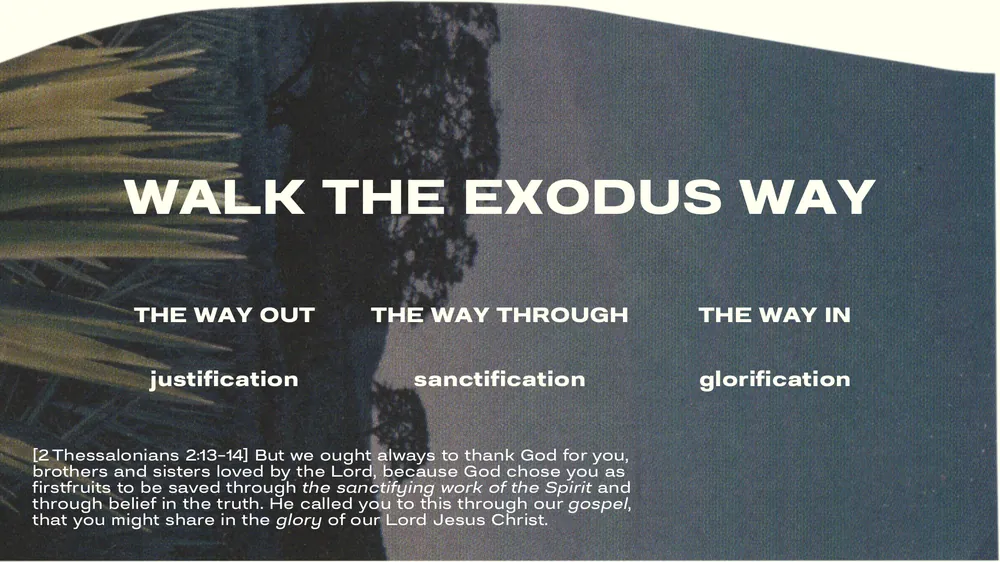
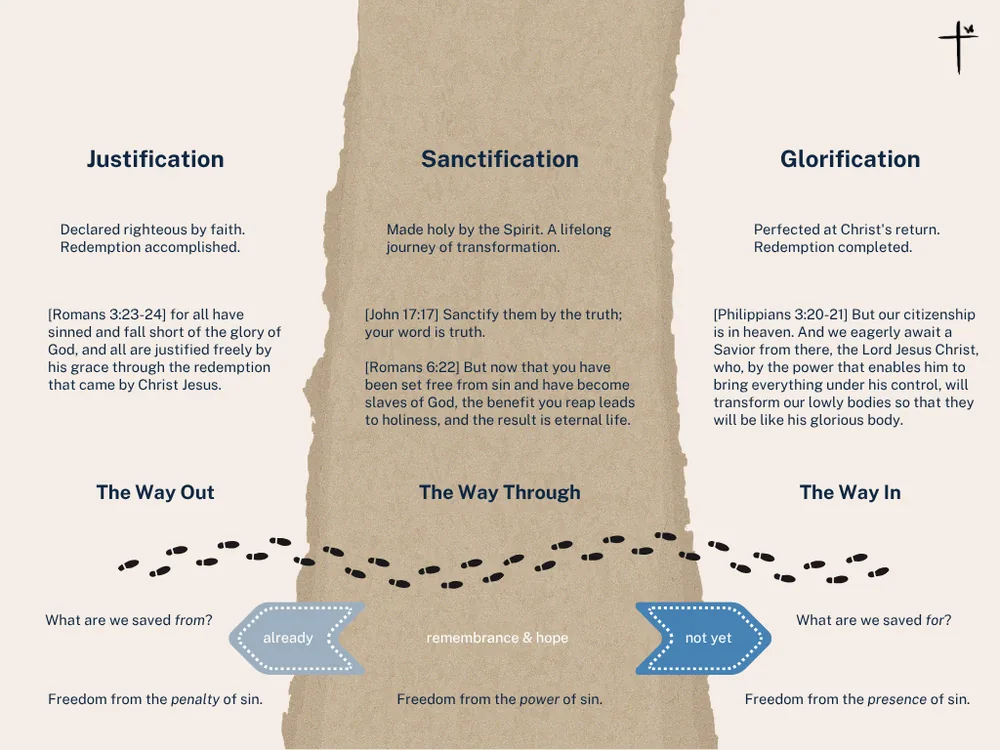
So what does it look like for us to walk the Exodus Way? We are already a new creation, but not everything has been restored yet. The dynamics of “already” and “not yet” reveal the two dimensions of salvation: what we are saved from and what we are saved for. The Exodus Way helps us see both sides clearly. The three movements map onto three familiar words.
The way out is justification: declared righteous by faith, redemption accomplished. “For all have sinned and fall short of the glory of God, and all are justified freely by his grace through the redemption that came by Christ Jesus” (Romans 3:23-24). This answers the question, what are we saved from? It is freedom from the penalty of sin, and it is already done; we do not have to cross the sea twice.
The way through is sanctification: made holy by the Spirit, a lifelong journey of transformation. Jesus prayed, “Sanctify them by the truth; your word is truth” (John 17:17), and Paul writes, “But now that you have been set free from sin and have become slaves of God, the benefit you reap leads to holiness, and the result is eternal life” (Romans 6:22). This is freedom from the power of sin. Just as the Israelites wandered in the wilderness between Egypt and the Promised Land, between Christ’s finished work and the future reality of glorification lies our lifelong journey of sanctification. We walk it in remembrance and hope: remembering the cross at the Lord’s table and hoping for the Kingdom banquet to come.
The way in is glorification: perfected at Christ’s return, redemption completed. “But our citizenship is in heaven. And we eagerly await a Savior from there, the Lord Jesus Christ, who, by the power that enables him to bring everything under his control, will transform our lowly bodies so that they will be like his glorious body” (Philippians 3:20-21). This answers the question, what are we saved for? It is freedom from the presence of sin. The Kingdom of God is already here and yet to come; in the new creation, we will enjoy the abundant life for eternity.
Paul puts all three together in one thanksgiving: “But we ought always to thank God for you, brothers and sisters loved by the Lord, because God chose you as firstfruits to be saved through the sanctifying work of the Spirit and through belief in the truth. He called you to this through our gospel, that you might share in the glory of our Lord Jesus Christ” (2 Thessalonians 2:13-14). Saved, sanctified, and called into glory. Grace grounds every movement; the wilderness is never self-salvation, but the Spirit’s work in a people already set free. And notice that the letter is written to brothers and sisters. Israel did not walk out of Egypt one by one, and neither do we. We walk the way through together.
Closing prayer
God’s faithfulness has a history. The covenants of the redemptive history, climaxed in the new covenant of Jesus, reveal the heart of the covenant-making, covenant-keeping God. The Exodus Way is not a map we study from a distance; it is a road we walk with a person. Jesus prayed on the night he was betrayed, “Now this is eternal life: that they know you, the only true God, and Jesus Christ, whom you have sent” (John 17:3). Knowing him is not only the destination at the end of the road. It is the road itself. Lastly, let us pray together:
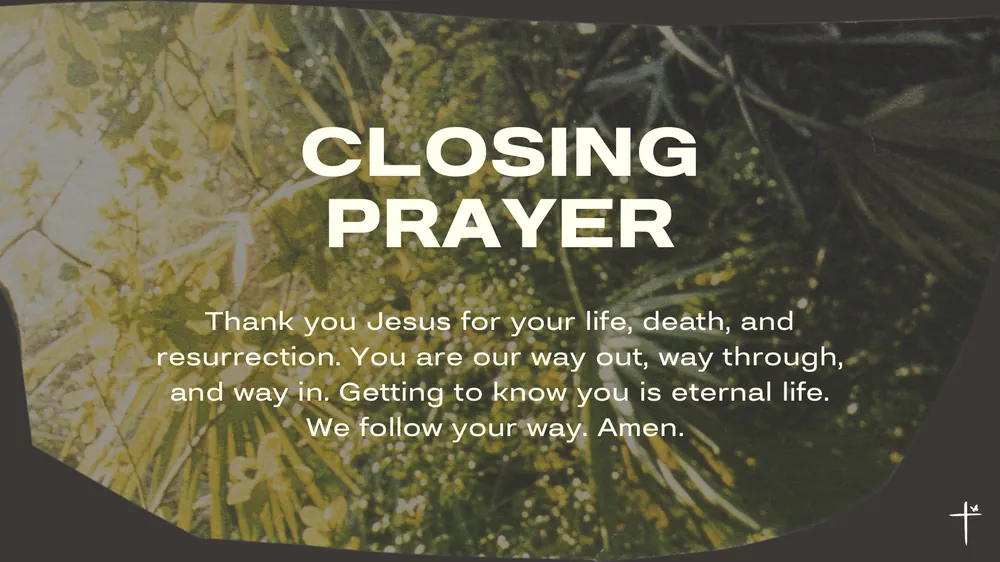
Thank you Jesus for your life, death, and resurrection. You are our way out, way through, and way in. Getting to know you is eternal life. We follow your way. Amen.
Paul Canaan
The slides
All 14 slides in one PDF, ready to project or print.
Bring it to your group
These resources may be used in churches, small groups, classes, discipleship cohorts, workshops, retreats and personal study. Before you lead one:
- Adapt the examples to your local context.
- Keep the biblical and theological structure.
- Don’t remove the formation practices just to save time.
- Prepare your facilitators before the group begins.
Full facilitator guides, with setup, timing, safety notes and discussion questions, are available on request. For teaching, publishing, translation, partnership or licensing, contact The Garden Project.